Cusick’s Camas
By Paul Slichter
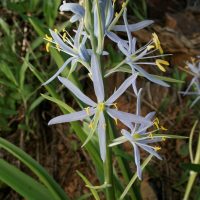
Local botanists have long recognized several patches of an odd camas growing above the Klickitat River. They didn’t quite match the Suksdorf’s camas (Camassia leichtlinii ssp. suksdorfii) or common camas (both C. quamash ssp. breviflora and ssp. quamash) which are the local camas in the area.
Fortunately, Susan Kephart, a specialist in camas taxonomy, was invited to look at the unusual camas by local plant enthusiast, Barbara Robinson.
Counting the Endangered Wenatchee Mountains Checkermallow

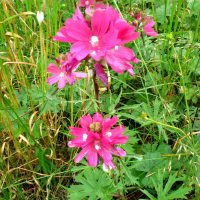
We can now answer the question, with a high degree of confidence, of just how many Wenatchee Mountains checkermallow (Sidalcea oregana var. calva) plants there are. That’s due to a 9-year effort to count and map its largest known population at Camas Lands near Peshastin, WA. This population holds nearly 90% of all known individuals of this species; therefore, it is important to know how large this population is and how it is changing over time.
Read moreWelcome to Anna Carragee, New Rare Care Program Staff Member

“I love getting the reports back from rare plant monitoring volunteers–hearing how their searches went and seeing photos from successful hunts.”
Read morePrime Prairie Time
Only 90 minutes south of Seattle is an exquisite but threatened habitat: the South Sound Prairies. Prior to the arrival of Euro-American settlers, the Northwest prairie ecosystem west of the Cascades thrived under management by Native Americans, from Oregon’s Willamette Valley north to the San Juan Islands and into southwestern British Columbia. Today, less than 3% of that original habitat survives, and plants dependent on the prairies’ unique soil and topography require vigorous protection.
Read moreUnraveling the Mysteries of Seeds

Sometimes it takes a while to unravel the mystery of seeds; other times they present no mystery at all. Take showy stickseed (Hackelia venusta) seeds as an example of the former. The germination ecology of showy stickseed was for years a mystery. Traditional propagation techniques using cold stratification yielded poor germination rates. Researchers experimented with various scarification techniques (altering the seed coat by weakening or creating an opening) and gibberellic acid, a plant growth hormone, to stimulate germination.
Read moreConserving plants by investing in people

It’s an early winter morning at the Center for Urban Horticulture greenhouse. While the sun considers rising, Sarah Shank greets her seedlings. Fueled by a passion for growing plants and her first cup of coffee, she describes her quiet mornings watering rare native plants as the perfect way to begin her workday. The current plants she tends to, Astragalus sinuatus (Whited’s milk-vetch) and Eriogonum codium (Umtanum buckwheat), she grew from seed and each day begins with observing them.
Read moreNotes from the Field

Despite unique challenges posed by the COVID-19 pandemic, the Rare Plant Care and Conservation program’s (Rare Care) volunteers successfully completed another busy field season of monitoring rare plant populations all across Washington State. The start of field work was delayed by the closure of most public lands, which gave us time to develop a Health and Safety plan for staff and volunteers.
Read morePreserving Partnerships and Unique Habitats

The Rare Plant Care and Conservation Program’s (Rare Care) partnership with the Washington Natural Heritage Program (WNHP) is invaluable and the relationships we build with their staff create a strong foundation for our program. As such, we like to spotlight the people we work with at WNHP like Joe Rocchio, the new Program Manager. Joe’s tenure for Heritage Programs began in 1999 when he worked for the Colorado Natural Heritage Program as a wetland ecologist.
Read moreSeeding for the Future

Last fall, the Rare Plant Care and Conservation Program (Rare Care) initiated a new study to investigate whether direct seeding is a viable alternative for establishing new populations of White Bluffs bladder-pod (Physaria douglasii ssp. tuplashensis). The only known population of this plant occurs at the Hanford Reach National Monument. It grows on the white bluffs along the east side of the Columbia River on a white cemented alkaline substrate rich in calcium.
Read more13th Annual Rare Plant Monitoring Weekend

Each year the Rare Plant Care and Conservation Program (Rare Care) hosts a weekend to monitor rare and threatened plants of Washington State. Trained monitoring volunteers, Rare Care staff, and National Forest staff work together to collect data on rare plant populations. This year’s monitoring weekend was held in the Colville National Forest. Based at Frater Lake, we camped below the stars and woke to the chattering of red squirrels busy with their daily chores.
Read more