Restoring Habitat for Species Recovery
Five years ago, Rare Care established vegetation plots in a population of Wenatchee Mountains checker-mallow (Sidalcea oregana var. calva) to evaluate how to control the spread of shrubs and non-native grasses in its habitat. This federally endangered plant grows in flat, seasonally wet meadows in Ponderosa pine, Douglas fir, or aspen forest openings, and is known from only two large and two very small extant populations in the Wenatchee Mountains.
Read moreNotes from the Field
Rare Care volunteers are known for going on some pretty extreme adventures each year to search for rare plants, and the 2023 monitoring season was no exception. From paddling down rivers to trekking up mountains and cliffsides, it doesn’t seem like there’s much that can stop our volunteers, except maybe the occasional rattlesnake encounter!
Volunteers Carol Mack, John Stuart and two friends took their canoes 10 miles up the Pend Oreille River to search the shoreline for lesser-bladder milk vetch (Astragalus microcystis).
Rare Care Volunteer Spotlights
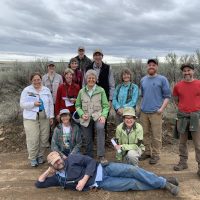
Each year Rare Care recognizes volunteers for their outstanding contributions.
Mickie Chamness trained back in 2005 and has completed 17 monitoring assignments and contributed over 140 volunteer hours. We really appreciate Mickie’s contributions to the botany surveys at Two Steppe and Marcellus Shrub Steppe NAPs, and her monitoring reports each year are excellent. We are so lucky to have her on the monitoring team for so long!
Plant Spotlight: Washington Polemonium
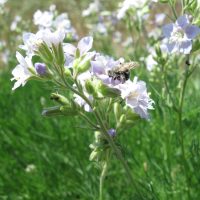
Washington polemonium (Polemonium pectinatum) is a distinctive perennial Washington endemic. As the Latin name implies, its leaves are pectinate, a term that describes its feathery, pinnately compound leaves that have 11-17 narrow leaflets. These unique leaves make this species stand out amongst other members of the genus in Washington. In mid-May to early June, its branched inflorescence blooms with light blue to lavender flowers that sometimes have faint maroon veins.
Read moreVolunteers Make a Great Find
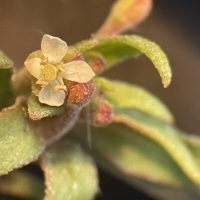
In early June, Rare Care volunteers Mickie Chamness and Janelle Downs stumbled upon a population of small evening primrose (Eremothera minor), a state sensitive plant species. It was actually on their way to another primrose monitoring assignment that they noticed the small population of 30 plants in the tracks of the dirt road they were hiking. This population of small evening primrose is one that Rare Care had previously searched for three times in that exact location, but never found any.
Read moreClimate Change Vulnerability in the Alpine

This past September, Rare Care completed a three-year study to assess the vulnerability of rare alpine plants. Working with the National Park Service (NPS), Rare Care staff and seasonal interns mapped and monitored 159 populations found in National Parks in Washington to climate change, installed 26 long-term monitoring plots, collected seeds, assessed 26 focal species’ vulnerability to climate change, and developed adaptive management strategies that NPS could employ to mitigate the impacts of climate change.
Read morePartner Spotlight: Tara Callaway, USFWS
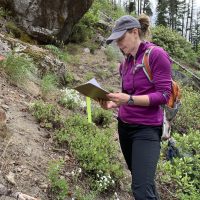
Did you know the U.S. Fish & Wildlife Service (USFWS) is one of the agencies responsible for administering the Endangered Species Act? Alongside NOAA Fisheries, USFWS is entrusted with conserving all federally listed fish, wildlife, and plants. USFWS is also a very important partner that Rare Care collaborates with on endangered plant species recovery. And we’re excited to highlight one of the people doing much of the behind-the-scenes coordination– introducing Tara Callaway!
Read morePlant Profile Chamber’s Paintbrush

If you have the fortune to be botanizing in southwest Washington, you might have the chance to encounter one of Washington’s rare paintbrush species. At first glance you might think this is the common, harsh paintbrush (Castilleja hispida) since both species have the same vibrant, orange-colored bracts and both are found at low to mid elevations. But it is in fact Chamber’s paintbrush (Castilleja chambersii), and when you look more closely at the leaves, you will see what is so unusual about this species.
Read moreExploring Marcellus Shrub Steppe Natural Area Preserve
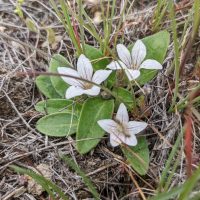
At the beginning of May, Rare Care staff and volunteers along with Department of Natural Resources (DNR) staff completed the first of two botanical surveys of the Marcellus Shrub Steppe Natural Area Preserve. The goals of this visit were to know what plants are there and re-find any previously documented rare plants. We also wanted to fill in knowledge gaps for shrub steppe species distribution and abundance that may contribute to designating a species for conservation status.
Read moreProtecting a Washington Rarity, the Endangered Desert Buckwheat
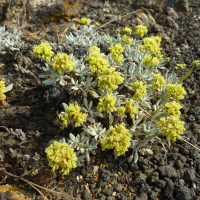
This excruciatingly rare plant has been documented in only one place: along a basalt ridgetop at the Hanford Reach National Monument.
Read more