Around the Farm: CSA Sign-up Season Has Begun
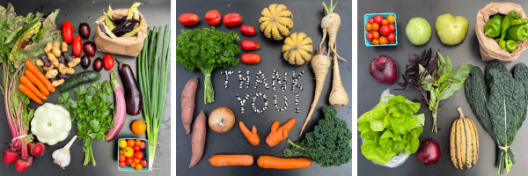
By Aisling Doyle Wade, UW Farm Production Manager
UW Farm CSA Shares On Sale Now!
Our crop plan is complete. Our seeds are neatly organized and tucked away in the cooler. In the greenhouse, we have already filled nearly all our allotted space with early flowers, alliums, brassicas and sprouting sweet potatoes!
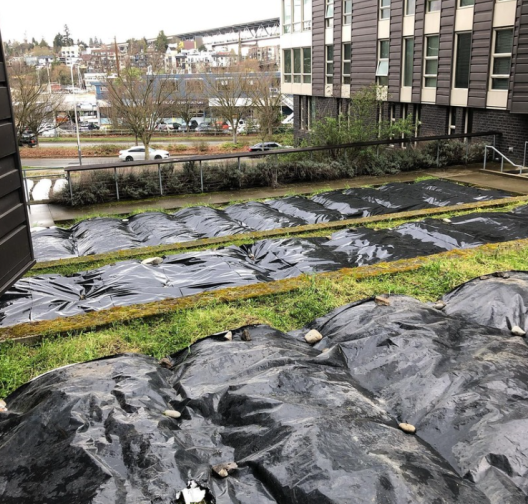
The UW Farm crew, with volunteers and students, have mowed much of the cover crop that grew extra thick and tall across the farm in the unseasonably warm weather. Over the chopped green mulch we have laid giant plastic tarps (pictured left) to exclude sunlight and accelerate decomposition into nutrient rich humus.
In the office, we have been working the phones and the computers – ordering the season’s supplies, readying recordkeeping systems, redesigning our intern program, coordinating academic activities, re-establishing partnerships, making new signage and so much more.
The groundwork is being laid for a productive and rich season. Now we are ready to turn to our community and ask – who will support our work in exchange for a share of our harvest?
Community Supported Agriculture (CSA) programs have, since their early origins, offered communities the ability to collectively support local farms and thus ensure that fresh, whole foods are locally available. In the 1960s & 70s, Booker T. Whatley (pictured right), a horticulturist and agricultural professor at Tuskegee University in Alabama, was thinking  about ways to help Black farmers survive the economic hardships of routinely being denied loans and other forms of support from the federal government. Whatley essentially devised the entire concept of a CSA in what he called ‘clientele membership clubs’. His idea was that Black communities could help ensure that their farmers were able to keep ownership of their land and keep producing food for the community if everyone pitched in financially at the beginning of the season. Members could then receive shares of the harvest throughout the season. Whatley emphasized that this system offered farmers guaranteed business and start-up capital at the beginning of the season while also imploring them to develop strong relationships with the community and maintain a healthy ‘club’ of members.
Similar concepts evolved in other parts of the world during a similar time period. Farmers in Europe gained inspiration for similar CSA style programs from the German philosopher Rudolf Steiner, who advocated for biodynamic and regenerative agricultural practices as well as the producer-consumer association. Additionally, E.F. Schumacher, a German & British economist, inspired community organizers and farmers with his advocacy for human-scaled technologies and locally scaled economies. In Japan, a group of women who were growing concerned over increasing food imports and a loss of local farming, organized direct farmer-to-consumer purchasing relationships which they  called ‘teikei’ which translates to “putting the farmers face on food”.
All these ideas have shaped the modern CSA programs that we are familiar with in the United States. Signing up for a CSA allows a community member to invest directly in a local producer who in turn operates at a local scale. CSAs offer community members a chance to use their food purchasing power to support their values.
Signing up for a UW Farm CSA is not only a way to access a weekly box of fresh, hyper local produce, it is also a direct investment in the farm’s work. Our CSA members support all the food systems and farming education, as well as student empowerment and community enrichment, that the UW Farm provides. Additionally, CSA revenue makes it possible for us to donate more than 6000 lbs of produce annually to our community.
Beyond the UW Farm, our region has no-shortage of small scale farmers and local producers who are committed to values community members may want to support. Some farms are committed to offering a sliding scale to CSA members so that folks with more financial resources can support access to fresh healthy food to those with less. Other farms offer CSAs that focus on culturally relevant foods from various cultures. Still other farms are hyper-fixated on 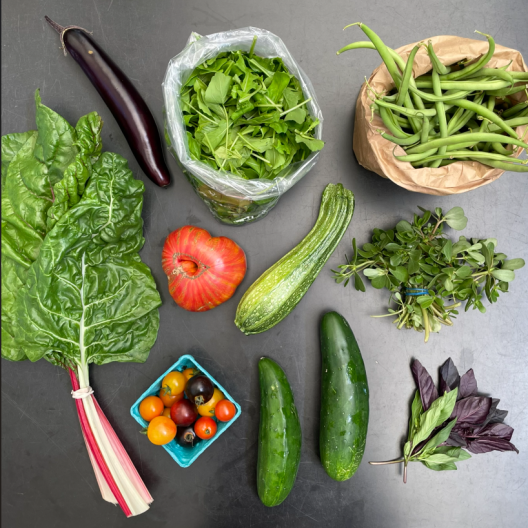 ecological management and regenerative practices that community members may prioritize. There are CSAs of all shapes and sizes – smaller box offerings for smaller households, options to pick up every other week, CSAs with meat and dairy products and CSAs that marry products from many local producers to offer a complete grocery basket!
Whether you plan to sign up for a UW Farm CSA or no CSA at all, we encourage everyone to explore Washington’s Eat Local First CSA Finder to explore many of the CSA options in the state and learn more about some of our local farmers.