July Color Appears at the Washington Park Arboretum
Chile in Seattle
1) Alstroemeria sp.
Commonly called Peruvian Lily or Lily of the Incas.
The genus was named after Swedish baron, Claus von Alstroemer (1736-1794) by his close friend, Carolus Linnaeus.
Beautiful drifts grace the Chilean Gateway.
2) Gunnera tinctoria
Sometimes referred to as Chilean rhubarb or dinosaur food.
The leaves can grow up to 2.5 meters across.
Several large clumps dot the Chilean Gateway hillside.
June Color Appears at the Washington Park Arboretum (Part II)
1) Callistemon sieberi (Alpine Bottlebrush)
This small, spreading shrub is currently showing off its creamy-yellow flowers in bottlebrush-like spikes.
Native to Australia, C. sieberi can be found along the footpath of the Australian Entry Garden within the Pacific Connections Garden.
2) Cytisus battandieri (Pineapple Broom)
Sometimes referred to as Argyrocytisus, this genus of Brooms fall within the family, Fabaceae.
Native to Morocco, C.
Summer Hours at the Miller Library
Summer is just around the corner, and with it comes summer hours at the Miller Library. The library will be opening at noon on Mondays (instead of 9am) starting June 17. Monday morning hours resume on September 23. We will be closed Saturdays, starting July 6. Saturday hours will resume September 7. We will also be closed July 4th and 5th for Independence Day.
Read moreJune Color Appears at the Washington Park Arboretum
1) Illicium henryi (Henry’s Star Anise)
This Chinese Illicium is a standout of the genus, as most anise have white or cream-colored flowers.
I. henryi can be found along the foot path of the Sino-Himalayan Hillside as well as along the Ridgetop Trail, just west of the Magnolia Collection.
2) Kalmia latifolia (Mountain Laurel)
This under-used Rhododendron relative is native to the eastern United States.
Read moreLearn by Doing: Volunteer at the Botanic Gardens
We need your help! We depend on volunteers to keep our gardens looking beautiful, our plant records up to date and the kids programs running smoothly. Apply online today!
Read moreJune 2013 Plant Profile: Lilium ‘Tiger Babies’
Striking elegance with remarkable hardiness and vigor, ‘Tiger Babies’ lily is considered a classic amongst lily growers worldwide.
Read moreMay Color Appears at the Washington Park Arboretum (Part II)
1) Aesculus x carnea ‘Fort McNair’
A hybrid between A. pavia and A. hippocastanum, it probably originated as a chance hybrid made by insects in 19th-century Germany.
Selected at the fort of the same name in Washington, D.C., flowers are pink with a yellow throat.
It can be found on Azalea Way, across from the Woodland Garden.
2) Buddleja globosa
A species of flowering plant endemic to Chile and Argentina, where it grows in dry and moist forest.
Read moreAnother Beautiful Flower
Free weekend walks for the month of May will feature many special flowers in our collection – like this small shrub, the Calycanthus x raulstonii ‘Hartlage Wine’ which sits outside the Graham Visitors Center.
Read moreBioblitz 2013 – What’s hatching in the Arboretum?
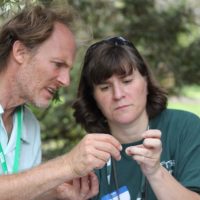
It’s nesting season right now, and we know where they’re nesting. Despite all this, however, the owl team got skunked. Not even a “who cooks for you”. The bat team, on the other hand, led by members from Bats Northwest, fared much better.
Read moreMay Color Appears at the Washington Park Arboretum
1) Acer circinatum (Vine maple)
Taken for granted around here, this time of year our vine maple is most eye-catching in flower.
Located throughout our native matrix as a deciduous forest understory tree.
Vine maple is native to the North American west coast from British Columbia to California.
2) Acer cissifolium (Vine-leaf maple)
Despite their similar common names, vine maple and vine-leaf maple could hardly be more different.
Read more