Experiments Towards Recovery
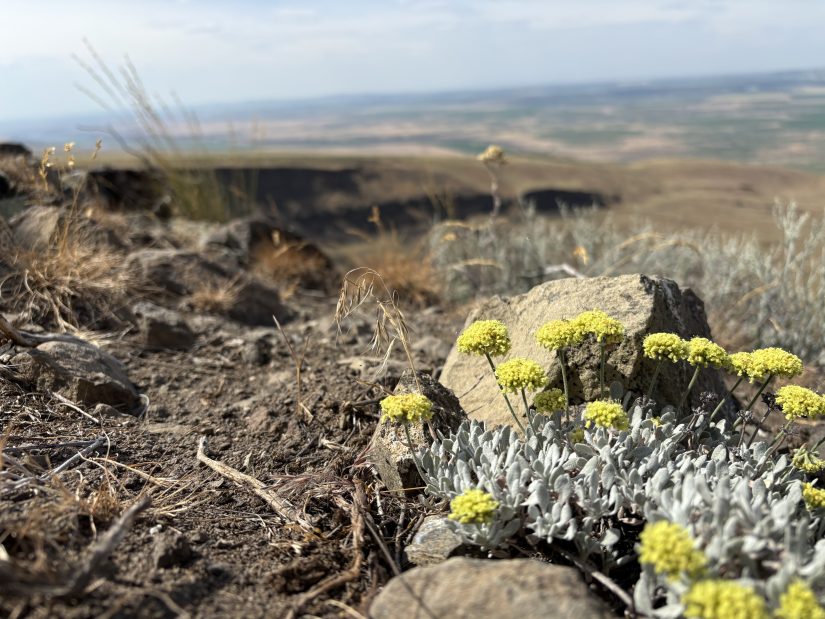
Whether it’s making rare seed collections or monitoring rare plant reintroductions, my summer as a field technician for Rare Care has been spent jumping from one project to the next. Despite the ever-changing nature of field work, one thing remained constant: every two weeks, Allie Howell and I would drive three hours to water an outplanted population of the low-growing, yellow-flowered Umtanum desert buckwheat (Eriogonum codium).
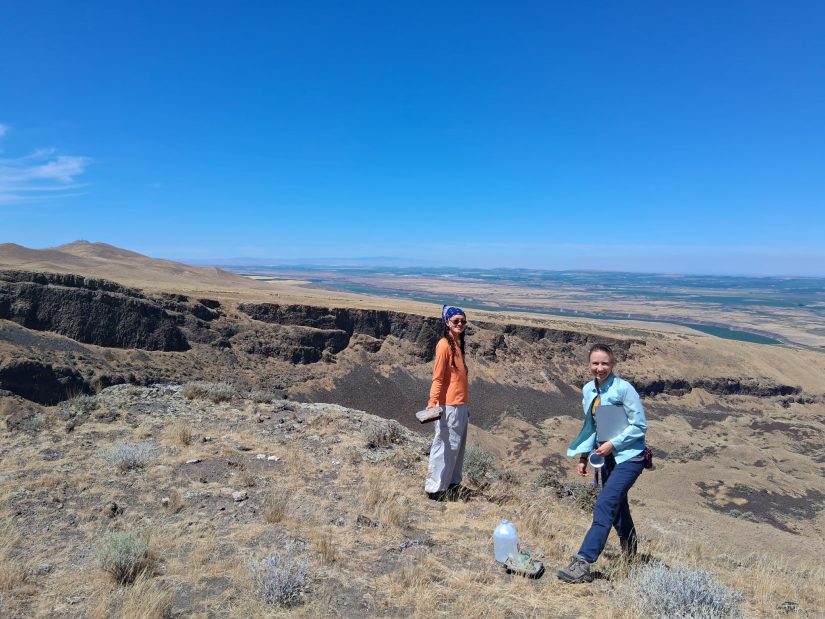
Growing along the top of a single basalt ridge, the entire native population consists of approximately 3,000 individual plants. With the increased threat of wildfire and this species’ low recruitment rates, efforts have never been more critical to protect this federally threatened, endemic species.
Over the past decade, experimental outplantings at four different locations have had limited success. One challenge has been establishing the tiny seedlings in this plant’s dry, harsh environment. The project I assisted on is addressing this issue by testing how varying the amount of water delivered to outplants every two weeks affect their survival at the Hanford Reach National Monument. Rare Care has planted plugs at this site annually since 2023. As of the end of July 2026, 37% of the seedlings planted in 2025 were still alive, and 79% of the seedlings that survived through the winter survived into mid-summer. This is the highest survival rate Rare Care has seen yet with this species at this site. Our experiment comparing the effect of different watering volumes is still ongoing, with updated data and results still to come.
As my field season wound down, I also participated in a burgeoning experimental trial to understand the germination requirements of Umtanum desert buckwheat to inform outplanting efforts. The goals of this project are to improve germination rates, decrease the time needed for seeds to germinate, and reduce nursery mortality rates of germinants. Over the next several months, Rare Care will be testing treatments including the efficacy of applying gibberellic acid, varying temperature and light regimes, and excising embryos to promote seed germination. As an avid seed lover, my favorite part of this project was excising the embryos out of the tiny, teardrop-shaped seeds. Using a pair of cushioned tweezers, a #10 blade, and a good microscope, I spent an afternoon excising 100 embryos to test if the seed coat may act as a physical inhibitor to germination.
While there is still much to learn about this little woody buckwheat, conservation of the species could not be attained if not for coordinated efforts of state, federal, and tribal partners.