2026 Notes from the Field
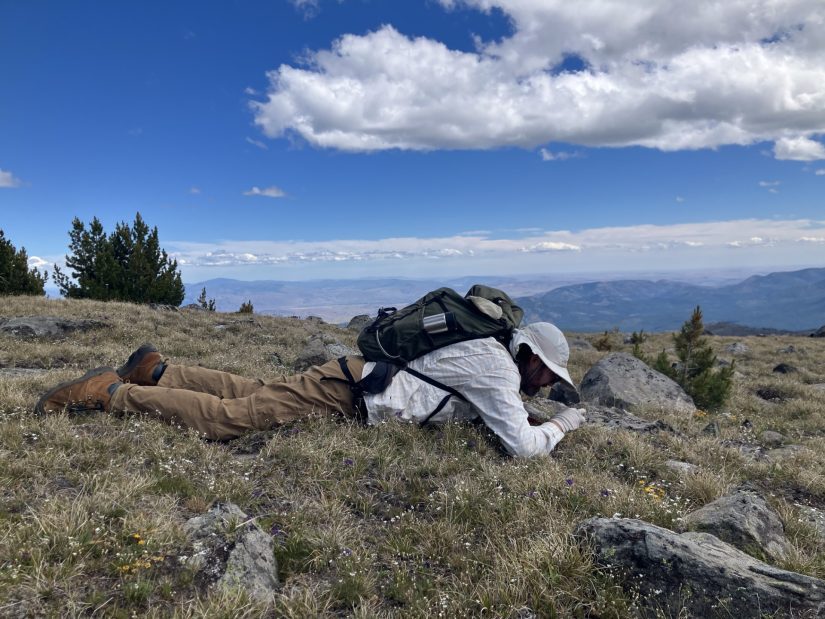
Rare Care monitors traveled here, there, and everywhere this field season, from the Olympic to the Blue Mountains, river valleys to alpine peaks. All in the pursuit of surveying rare plants.
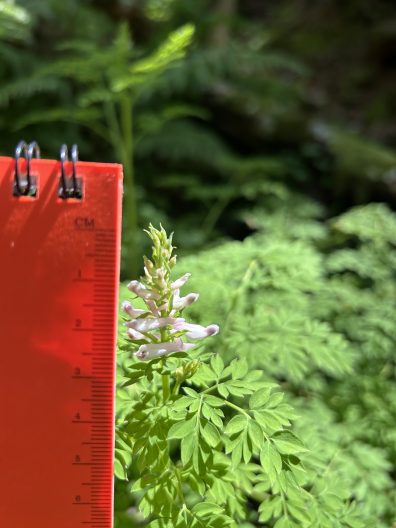
Photo by: Zoe Loutos
Teamwork, determination, and luck went in to finding annuals this year. Joanna Long, Sarah Stolar, and Tiffani Manteuffel-Ross created a rotating schedule to try to relocate a population of white fairy-poppy (Meconella oregana) in Island County that had not been found the last two years. The incremental visits proved successful, as Joanna found one small subpopulation on the second search. Two weeks later though, when Sarah went to find the other subpopulation, the first one had already senesced. Ephemeral little fairies, indeed.
New volunteer Jeff Wills went looking for dwarf suncup (Eremothera pygmaea) up a steep and loose scree slope in Grant County. On his first attempt, he didn’t find any plants. Determined to locate the population though, Jeff returned a month later, again scaled the precarious slope, and to his delight found 28 little plants flowering.
Erika Schreder tasked herself with finding a needle in a haystack: a common bluecup (Githopsis specularioides) population that was last recorded in 2003 with only 5 plants. The land manager gave her a tip on how best to hike up to the steep, open slope where the population was last found. As luck would have it, approaching from this direction instead of a more direct way, she stumbled upon the plants as soon as she walked onto the bald and counted 27 individuals hiding amongst perennial grasses.
Our surveyors had a challenging year to get to some sites as the December 2025 floods damaged many roads on public lands. That didn’t deter Zoe Loutos. On the way to her roadside site, she encountered a heavily rutted road. Instead of turning around, Zoe drove as far as she could, then walked the remaining mile of damaged road to reach a healthy population of marsh corydalis (Corydalis aquae-gelidae) that had not been surveyed for 36 years.
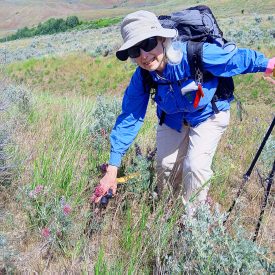
Barbara Varnum-Finney carefully coordinated with several private landowners in Douglas County to survey and collect seeds of Thompson’s clover (Trifolium thompsonii), a Wenatchee Mountains endemic. She assembled a group of experienced volunteers, including Julie Bresnan, Jeff Thorson, and Marilee Henry, to assist her. The group not only found the population but also greatly expanded its boundaries. Their seed collection is one of 33 from this year that is part of a grant with the Center for Plant Conservation.
We spent this year’s monitoring weekend with 18 volunteers at Tiffany Mountain in the Colville and Okanogan-Wenatchee National Forests. Our targets for the weekend were snow cinquefoil (Potentilla nivea), pink agoseris (Agoseris aurantiaca var. carnea) and tall agoseris (Agoseris elata), among others. We were greeted with the endemic Washington beardtongue (Penstemon washingtonensis) growing at the campground right under our noses and a confusing array of morphological traits in Agoseris plants. After visiting five populations, we surmised more work needs to be done to understand tall agoseris variation in the area. In total, we surveyed 15 rare plant populations and found four potentially new ones.
Over a hundred pairs of feet have driven, biked, hiked, and climbed to reach rare plant populations across the state this year. Our volunteers often don’t know what they’re going to find when they set out to survey, but the information they collect is crucial in moving us further along the path of plant conservation.