December Plant Profile: Magnolia tamaulipana

Common name: Tamaulipana Magnolia
Origin: Cloud forests in El Cielo Biosphere Preserve, Nuevo Leon, Mexico. It is endemic to the El Cielo Preserve along with Oak (Quercus), Sweetgum (Liquidambar), Pine (Pinus), Engelhardia, Dendropanax, and Podocarpus.
Only 8 populations are known. Seven populations are distributed in tropical montane cloud forest and one in oak pine forest.
Status: Endangered (EN)
USDA Hardiness Zone 7-10
Appearance: M. tamaulipana is a beautiful evergreen tree with fragrant creamy flowers. It looks very similar to Southern Magnolia (Magnolia grandiflora) which it is very closely related to. There is a cultivar called ‘Bronze Sentinel’ that flushes with purplish bronze new growth in spring which turns dark green as time goes on. It purportedly remains narrower than the species and has good heat and cold tolerance. We have ‘Bronze Sentinel” at the Center for Urban Horticulture. It is at the southwest side of the Soest Garden. It is about 9′ high at present.
Height and Spread: Magnolia tamaulipana can reach up to 30 m in height and 40–50 cm in trunk diameter at breast height
Bloom time: Flowering sporadically from May to July, with fruits in fall. The flowers are large and fragrant. Flowers start out female then become male (being protogynous which helps prevent self-pollination). Flowers of M. tamaulipana open at night and are viable for 24 hours.
The blooms produce heat and scent to attract their beetle pollinators. Flowers are hottest when they first open and are female. One study said that excess floral temperatures reached up to about 16 degrees F warmer than ambient temperatures. So cozy for the beetles to spend the night in a warm, fragrant, edible bloom!
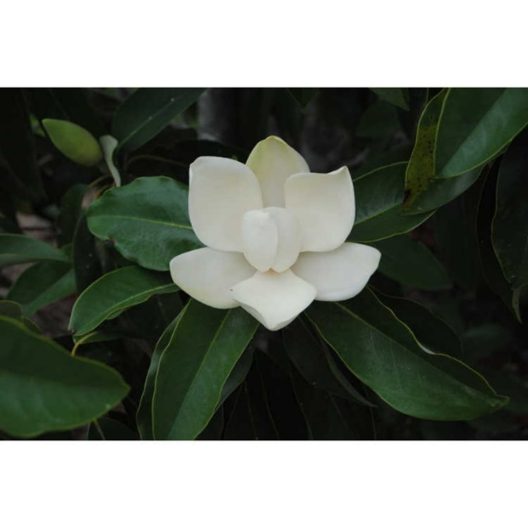
Pollinators: The major pollinators are species of scarab and rove beetles. The scarabs partake of the carbohydrate-rich tepals, while the rove beetles feed on the pollen. Generating heat increases scent dissipation. Large flowers are warmest and attract the most beetles. One study reported that “Of the 366 insects visiting 213 flowers of M. tamaulipana, 364 were beetles”. As a general rule Magnolia species that are pollinated by beetles active during the day produce heat and fragrance only during the day. Magnolias like M. tamaulipana that are pollinated by nocturnal beetles only produce heat and fragrance at night. They don’t waste their energy.
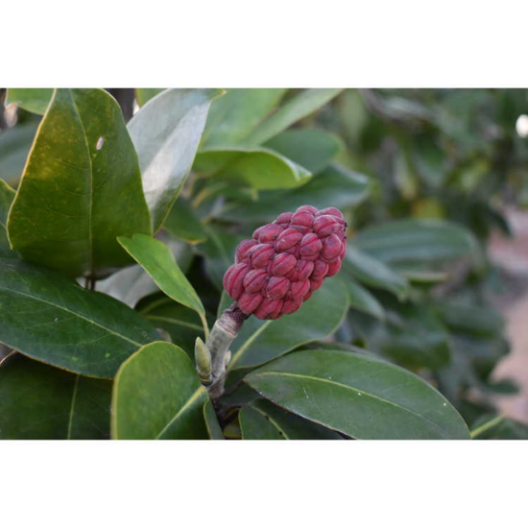
Location in the arboretum: The International Dendrology Society says that the oldest known cultivated specimen is at Washington Park Arboretum, Seattle! Our largest tree is from a seed from the Missouri Botanic Garden from 1948 (grid 25-1W). It first bloomed in 1971. A good view is from Azalea Way. It is a little south of the Rhododendron hybrid beds and is east up the hill from a beautiful Chinese Hornbeam, Carpinus fargesiana. It is evergreen and easily seen with a large lichen covered trunk. It currently has a couple of reddish fruits on its south side barely visible from Azalea Way.
We have a younger specimen on the west side of the path from the winter garden to the woodland garden bridge: (grid 33-1A), and one near the bench in the Asian Maple collection; (grid 27-1E). Washington Park Arboretum (public map)
Research into human uses: Magnolia tamaulipana powder extract inhibited egg laying and food intake of adult female red spider mites. It could be promising as a control agent for spider mites which are a problematic garden and greenhouse pest.
Interesting sources of more information:
In Defense of Plants Blog https://www.indefenseofplants.com/blog/tag/Magnolia+tamaulipana
International Dendrology Society https://www.treesandshrubsonline.org/articles/magnolia/magnolia-tamaulipana/
The University of Chicago Press Journals https://www.journals.uchicago.edu/doi/full/10.1086%2F717817
January 1999 International Journal of Plant Sciences160(1):64-71https://www.researchgate.net/publication/240563778_Beetle_Pollination_and_Floral_ Thermogenicity_in_Magnolia_Tamaulipana_Magnoliaceae