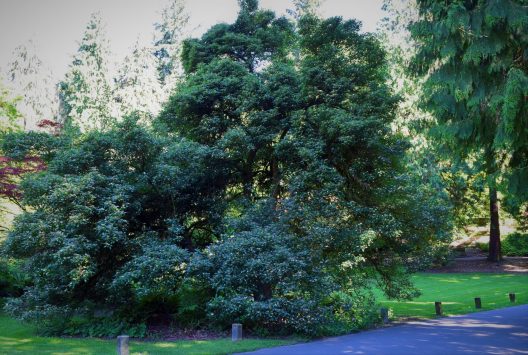
Spring may delight us with color, but throughout the year we can appreciate other sensory elements in Washington Park Arboretum’s collections. Leaves and blooms can give off powerful aromas. Texture and plant shape can provide a sense of drama or reverie. Enjoy all your senses with these plant choices!
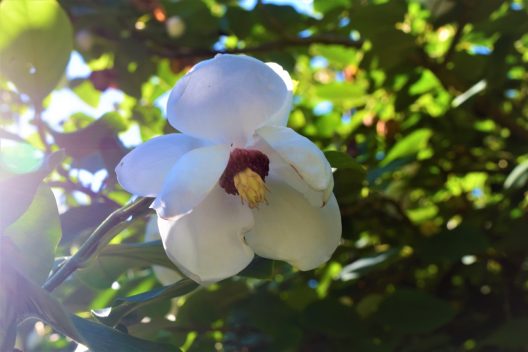
1) Magnolia sieboldii Oyama Magnolia
Egg-shaped in bud, the white nodding flowers have a crimson stamen and leaves behind a showy pink fruit.
Native range is southern China, Japan and Korea.
It is happily growing in a protected spot on the west side of the Graham Visitors Center. It anchors the north end of the Wisteria trellis.
Megan Westcott
Magnolia sieboldii
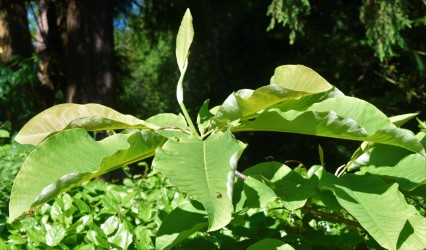
2) Magnolia tripetala Umbrella Magnolia
If it rains, you may be drawn to the umbrella-like whorls of lime green leaves on this tree.
The national champion of this species is in Bucks County, Pennsylvania and is 50 feet tall and wide.
The north entrance to Azalea Way is graced by the tripetala growing above a short rock berm.
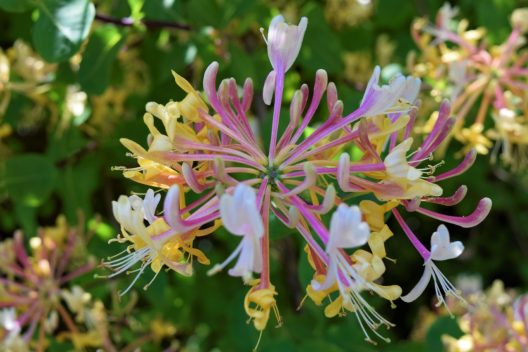
An immense mass of flowers are now present, perfuming the area with a sweet, spicy aroma.
This vining shrub will produce tubular flowers attracting bees, butterflies and hummingbirds.
You can find it growing along the west fence line of our nursery. Its native range is southern central Europe to the Caucus Mountains and Mediterranean Sea.
Megan Westcott
Lonicera etrusca ‘Visidula’
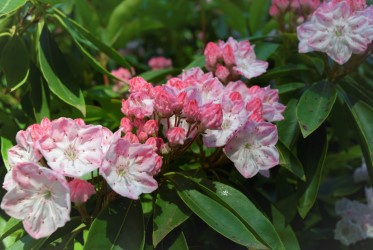
4) Kalmia latifolia Mountain Laurel
As the state flower of Connecticut, this small tree or shrub has pleasingly dense, evergreen foliage. Its bi-colored blooms have a candy-like appearance.
Old trunks and limbs become gnarly and twisted.
Known to grow on Balds (primordial mountain tops in the Southern Appalachian range), ours can be found just south of the Woodland Garden.
Megan Westcott
Kalmia latifolia
5) Cretaegus x lavalleei ‘Carrierei’ Hawthorne
Normally a small tree, this example in our collection is a giant. Its glossy green leaves will turn shades of crimson in the fall.
With its graceful trunk and late spring/early summer flowering with large white clusters of blooms, it provides four seasons of interest.
A stately tree, it can be found at the southern edge of the lawn fronting the Woodland Garden.