UWBG Horticulture Job Opening! 75% permanent Gardener 2 @ CUH is now posted!!!
.75% permanent gardener 2 position based @ our Center for Urban Horticulture. .
A mix of restoration ecology and horticulture maintaining CUH gardens and grounds, including the Union Bay Natural Area and Yesler Swamp.
UW Hires Link:
https://uwhires.admin.washington.edu/eng/candidates/
Job Req.# is: 206482.
Closes on May 25
The Weekly Dirt 5.4.22
5.04.22
Around The Farm
How Sourcing Seeds Locally Models Sustainable Growing Practices
By Dannette Lombert, AmeriCorps Member, Food Security Lead
With spring off to a strong start many of you are probably elbow deep in your gardens and growing spaces, trying to take care of all the new seedlings and crops that are starting to grow.
For those who like to grab starts – potted plants that have germinated and growing for a couple weeks – this is also the time when many plant sales are going on and when folks may be starting to source seeds.
Spring in the Woodland Garden 2022
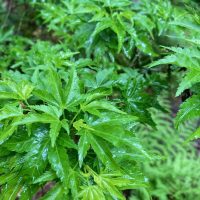
1) Bright Green Maples
Even the common color of green inspires hope and energy in spring. Here are two exceptional examples:
Acer palmatum ‘Shishigashira’, known as the Lion’s Mane maple, was so named for the curled, bunched up leaves at the ends of short, stout stems.
Acer japonicum ‘Ed Wood’, located in the Signature Bed at the Graham Visitor Center, sports exceptionally robust foliage for a blast of color in both the spring and autumn.
The Weekly Dirt 4.27.22
4.27.22
Around The Farm
Earth Day: In Case You Missed It!
By Dannette Lombert, AmeriCorps Member, Food Security Lead
We had an exciting weekend, celebrating Earth Day with the ribbon cutting of our Vermicompost Unit! All across UW there were numerous events, especially in the Seattle and Greater Seattle Area
In case you weren't available to attend our ribbon cutting, below is a photo album, from top left going clock wise: Margaux Ranson, former UW Farm Education Intern ('21) and creator of educational signage, UWBG Director, Christina Owen, Julia Macray, Mary Gates Scholar and Vermicompost Intern, and Uw Farm student staff, Kove Janeski at the ribbon-cutting, David Zuckerman, UWBG Horticulture and UW Farm Manager, Perry Acworth, field questions from attendees.
The Weekly Dirt 4.20.22
4.20.22
Around The Farm
Vermicomposting: Small Livestock, Big Impact!
By Dannette Lombert, AmeriCorps Member, Food Security Lead
The UW Farm will officially have livestock on the farm: red wigglers! This week we are welcoming the worms as part of our NEW CSF-funded vermicomposting facility, the result of a grant written by Michael Bradshaw, PhD '20. After more than five years of collaboration and hard work, the ribbon-cutting will be this Friday as part of Earth Day festivities on the UW Seattle campus (see details below).
2022 Speaker Series: New Directions in Public Gardens

As a public garden, it is vital that we work with integrity to serve all communities and make sure our spaces and programs are welcoming and relevant to all.
At UW Botanic Gardens, we are thinking deeply about the mission of our organization and public gardens as a whole. We see ourselves as a resource for community education and engagement, a steward of urban green space for recreation and restoration, and curators of collections with important conservation value.
The Weekly Dirt 4.13.22
4.13.22
Around The Farm
An Introduction to our Mary Gates Leadership Scholars:
This quarter we are excited to announce that two UW Students, who have volunteered with us regularly throughout their time at UW, applied and were accepted to be Mary Gates Leadership Scholars! They each will be working on a project on the Farm across two quarters. We would like to introduce them to the greater UW Farm community, as you all will be seeing a lot of them and their work for the rest of the growing season.
Read moreAn Overview of The Washington Park Arboretum Master Plan
A master plan is critical for a botanic or public garden of any size, to give it a sense of mission and purpose, and then to guide priorities to accomplish its goals.
Read moreA Vibrant, Welcoming and Diverse Future for UW Botanic Gardens: UWBG’s Co-Directors in Conversation
“The Arboretum is over 230 acres and it is absolutely a public space. And when we say public that means everyone, not just the people that live close by,” says Christina Owen, co-director of UWBG.
Read moreI’m Lichen What I’m Seeing!
Let’s dip our toes into the bizarre world of lichens! Lichens are those interesting, colorful, strange little growths found on trees and stones that are commonly mistaken for moss. Lichens and mosses can certainly grow together and often do, but they are far from the same thing. These underappreciated epiphytes are actually not even plants at all. They are a symbiotic combination of fungi and algae which form an estimated 3,600 (and counting) different species of lichen throughout North America.
Read more